
Confirm your age
Please verify that you are 18 years of age or older to enter this site.



Last Updated: September 30, 2026
Knowing how to batch classic gin cocktails for hosting is the difference between spending your party stuck behind a shaker and actually enjoying it. This guide from Letterbox Cocktails walks you through the whole process: the tools, the maths, the recipes, and the storage rules.
Here is the core idea. You make one big jug of a single drink, chill it properly, and pour it all night instead of shaking each glass one at a time.
That saves you roughly 40 minutes of work across a three-hour party. It also means your drinks taste consistent, because every pour comes from the same mix.
Most guides skip the two things that actually matter: dilution and freshness. Get those right and your batched drinks can be excellent. Get them wrong and you risk serving warm, watery versions of drinks.
Below, we'll show you exactly how to batch, chill, store, and serve classic gin cocktails for a crowd of any size.
The essential tools for batching drinks are simple: one large vessel, one measuring jug, one long spoon, and enough fridge space. You do not need a full bar setup.
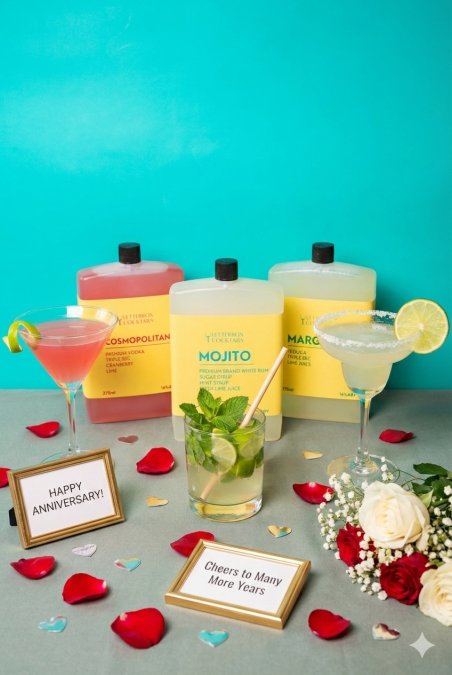
Here is what earns its place on the counter:
Skip the cocktail shaker. It has no job here.
A glass pitcher works for smaller batches and looks good on the table. For anything over 2 litres, use a large food-grade container with a lid.
A punch bowl is the classic choice, and it earns its keep at bigger gatherings. Just remember it holds ice, which dilutes your mix as the night goes on.
Plastic is fine for transport. Glass is often preferred for flavour.
Dilution is the water and melted ice that a cocktail picks up while it is stirred or shaken. Without it, your drink tastes sharp and hot. With too much, it tastes thin.
Go Bigger Party Pack – 12 Premium →
This is the part most hosts get wrong. A stirred drink picks up roughly 20 to 25 percent of its volume in water. A shaken drink picks up closer to 30 percent. If you skip this step entirely, your batch will taste stronger.
Use these numbers as your starting point:
| Drink Type | Water to Add | Method |
|---|---|---|
| Stirred (Martini, Negroni) | 20% of total volume | Stir with ice, then strain |
| Shaken (sours, fizzes) | 30% of total volume | Shake hard, then strain |
| Built (G&T style) | 0% | Add tonic when serving |
So for 1 litre of stirred cocktail, add 200ml of cold water. For the same volume shaken, add 300ml.
You do not need to memorise percentages. Use this formula:
Water to add (ml) = Total batch volume (ml) × Dilution percentage
For a stirred drink, use 0.20. For a shaken drink, use 0.30.
Example: You are making 2 litres of Negroni (stirred). 2000ml × 0.20 = 400ml of cold water. Add that to your mix, stir well, and chill.
If you are scaling up for a party, work out the total volume of spirits, vermouth, and syrup first, then apply the percentage. Do not include the water in your original volume, add it after.
Many hosts think they can just add ice to the batch and let it melt. However, ice melts at different speeds depending on room temperature and how often you open the fridge, which can lead to inconsistent drinks. Measured water helps ensure a consistent drink from first to last.
If you want to serve over ice, that is fine, but treat that ice as extra dilution.
The best gin cocktails for parties are often those with three or four ingredients and no last-minute steps. A classic Martini, a Negroni, and a gin sour can all be batched effectively.
Small changes in a single glass become big changes in a jug. Two rules keep you safe.
Go Bigger Party Pack – 12 Premium →
Batch cocktail storage tips come down to three things: cold, sealed, and short. A well-made batch keeps for 2 to 3 days in the fridge.
Follow these rules:
Carbonated cocktails can be challenging to batch, and many guides focus on other types. If you build a gin and tonic in a jug the night before, the bubbles will likely be gone by morning.
Fresh citrus needs the same care. Juice can lose its brightness within hours, so squeezing on the day is often recommended. Bottled juice can taste different and may impact a batch.
A few practical points:
Once you mix fresh juice into a batch, the clock starts ticking. The juice will start to oxidise and lose its zing. Here are safe limits:
Serving well is about temperature and speed, and that is the last piece of how to batch classic gin cocktails for hosting. Keep the batch in the fridge until the first guest arrives, then move it to a serving station with ice.
Set up like this:
Yes, most classic gin cocktails can be batched up to 24 hours ahead and stored in the fridge. Stirred drinks like the Negroni or Martini hold well for 2-3 days if kept cold and sealed. Shaken drinks with fresh citrus are best made the same day. Always add carbonated mixers and ice just before serving to keep the fizz and avoid watering down your batch.
Dilution replaces the water that ice would normally add during shaking or stirring. For a stirred drink like a Martini, add about 20-25% of the total volume in water. For shaken drinks, use around 25-30%. If you plan to serve over ice, reduce added water slightly because the ice will continue to melt. Taste a small sample before your guests arrive and adjust.
The Negroni, Martini, Gin Fizz, and Tom Collins all batch well. The Negroni is often considered straightforward because it is equal parts gin, vermouth, and Campari, making scaling simple. The Martini benefits from careful dilution and is typically stirred, not shaken, in large quantities. The Gin Fizz and Tom Collins require soda water, which you should add per glass rather than to the main batch to preserve carbonation.
Stirred gin cocktails without fresh juice keep for 2-3 days in a sealed container in the fridge. Drinks with fresh citrus juice are best within 24 hours because the juice oxidises and flavours fade. Always label your batch with the date and keep it at 4°C or below. If you notice any off smell or cloudiness, discard it.


£19.95 GBP
Unit price per